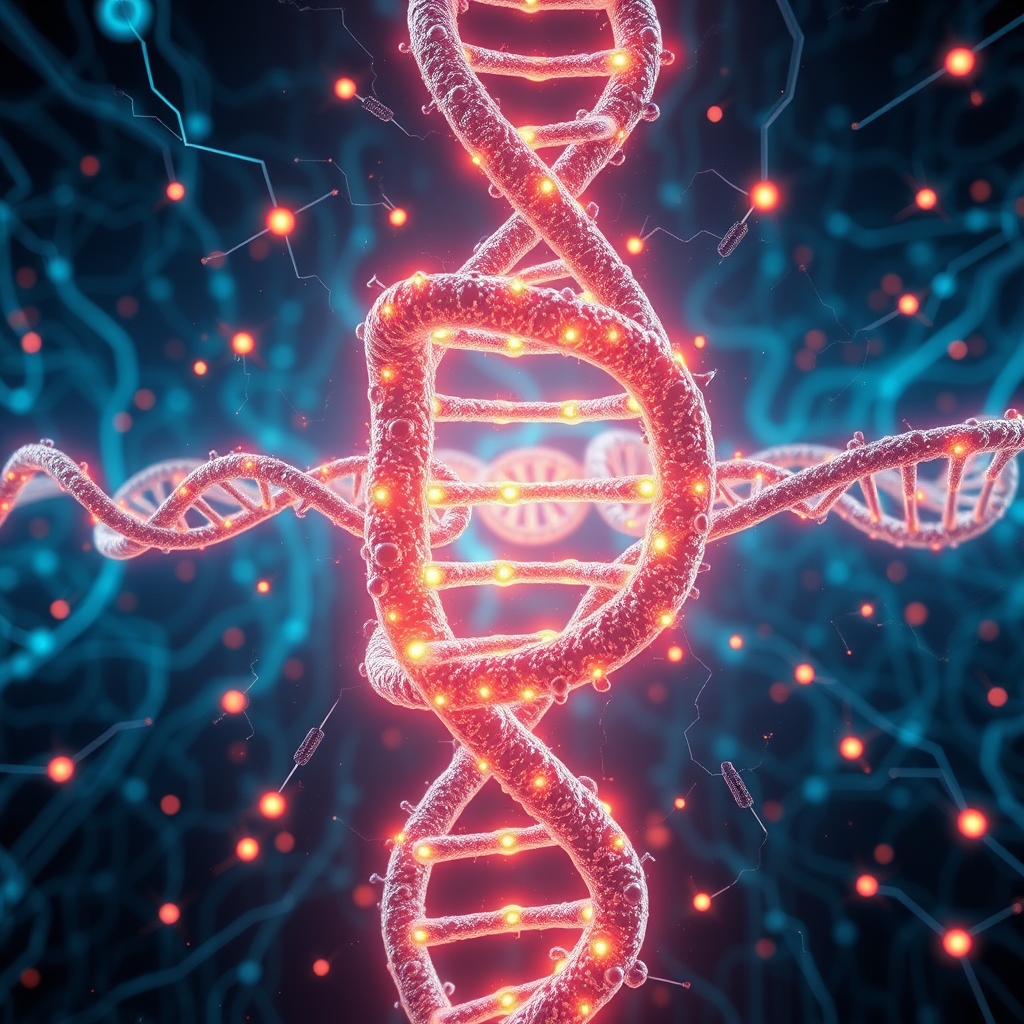
The D in DNA stands for deoxyribose. That is not trivia. It is a reminder that your entire genetic archive rests on a sugar backbone. Every one of your 3.2 billion base pairs depends on this molecular scaffolding. Before you were a developer, a problem solver, or even a multicellular organism, you were chemistry that learned to copy itself. The path from those first self-copying molecules to the commit you pushed this morning is long, unbroken, and stranger than most technology origin stories. Understanding that path changes how you see your work.
From Lunch to Legacy
Sugar is not just fuel. When you eat glucose, your body routes it through several metabolic options. It can burn the molecule immediately for ATP, store it as glycogen, or send it down the Pentose Phosphate Pathway. This pathway operates in the cytoplasm of your cells and serves as one of metabolism’s busiest crossroads. Through a series of oxidative and carbon-swapping reactions, the six-carbon glucose skeleton is trimmed and rearranged into Ribose-5-phosphate, a five-carbon sugar.
That ribose derivative is not waste. It feeds directly into the synthesis of dNDPs, the deoxyribonucleoside diphosphates your cells use to string together new DNA. The same pathway also generates NADPH, the reducing currency that powers everything from fatty acid building to antioxidant defense. Your lunch and your genome share the same raw material.
Think about this the next time you are debugging at 2 p.m. The glucose keeping your brain alert is part of the same molecular stream that repairs the DNA in your neurons. You are not merely consuming fuel. You are processing the very material that makes you exist. The abstraction layers we build in software, functions calling libraries calling kernels, have a biochemical parallel. Your cells abstract sugar into energy, repair, and replication without a single conscious decision. You do something similar when you compile source code into a binary. Both processes translate raw substrate into something functional.
Error as Architecture
This biochemical precision did not arrive fully formed. It began roughly 3.8 billion years ago with molecules that could copy themselves. The most important feature of this system was its imperfection. A perfect copy machine would have produced a static world, a dead end of identical molecules. Instead, errors slipped in. Most broke things. Some did nothing. A rare few produced variants that copied faster, lasted longer, or survived better under local conditions. That imperfection is evolution.
You can think of evolution as an experiment running without a lab manager. Random mutation proposes the trial. Natural selection reads the result. Extinction is the failure to adapt. There was no senior architect reviewing pull requests, no sprint planning, and no rollback strategy. There was only raw selection pressure: heat, cold, starvation, radiation, predation, and competition. For billions of years, that was the only guide. The output of that trial-and-error process is sitting in front of you right now, reading text on a device made from refined sand.
The Stack Builds Up
Life’s progression is not a ladder. It is a stack of increasingly complex abstractions laid one on top of the other.
- Self-replicating chemistry learned cooperation, becoming multicellular organisms.
- Some lineages developed centralized nervous systems, and one branch produced self-aware humans.
- Awareness gave rise to language, then symbolic representation, then mathematics.
- We built machines to manipulate symbols faster than neurons could fire, leading to computation and artificial intelligence.
For most of history, life only ran the program. DNA executed its instructions through proteins, and organisms reacted to their environments. Humans became the first species to read the source code. Mendel counted peas. Watson and Crick modelled the double helix. We sequenced genomes and mapped metabolic networks. Then we moved decisively from reading to writing. We edit genes with CRISPR, synthesize novel organisms, and train neural networks on silicon wafers.
Каждая абстракция, которую вы прописываете в своем коде, — это крошечное продолжение того древнего процесса. Когда вы импортируете библиотеку, чтобы не переписывать алгоритм сортировки, вы опираетесь на накопленные знания точно так же, как биология выстроила клеточные механизмы на базе химических реакций. Когда вы контейнеризируете приложение, вы целенаправленно управляете репликацией и средой — тем, чего молекулы когда-то достигали лишь случайно.
Разница между слепотой и намерением
Нынешняя волна помощи ИИ вызвала реальную тревогу по поводу возможной замены людей. Такая постановка вопроса скрывает более глубокую преемственность. Эти инструменты усиливают человеческое намерение. Они сокращают время между идеей и её реализацией. То, на что у младшего разработчика раньше уходили часы написания шаблонного кода, теперь может занять считанные минуты. Но направление всё равно выбирает человек, держащий курсор.
Это подлинно новое явление. На протяжении 3,8 миллиардов лет эволюция была слепой. У неё не было ни цели, ни дорожной карты, ни пятничных ретроспектив. Вы несете все эти исследования и разработки в своих клетках, и всё же вы — первое звено в цепи, способное смотреть вперед. Эволюция реагирует на вчерашнюю среду. Вы же можете планировать завтрашние требования. Когда вы вместо этого проводите рефакторинг хрупкого legacy-кода