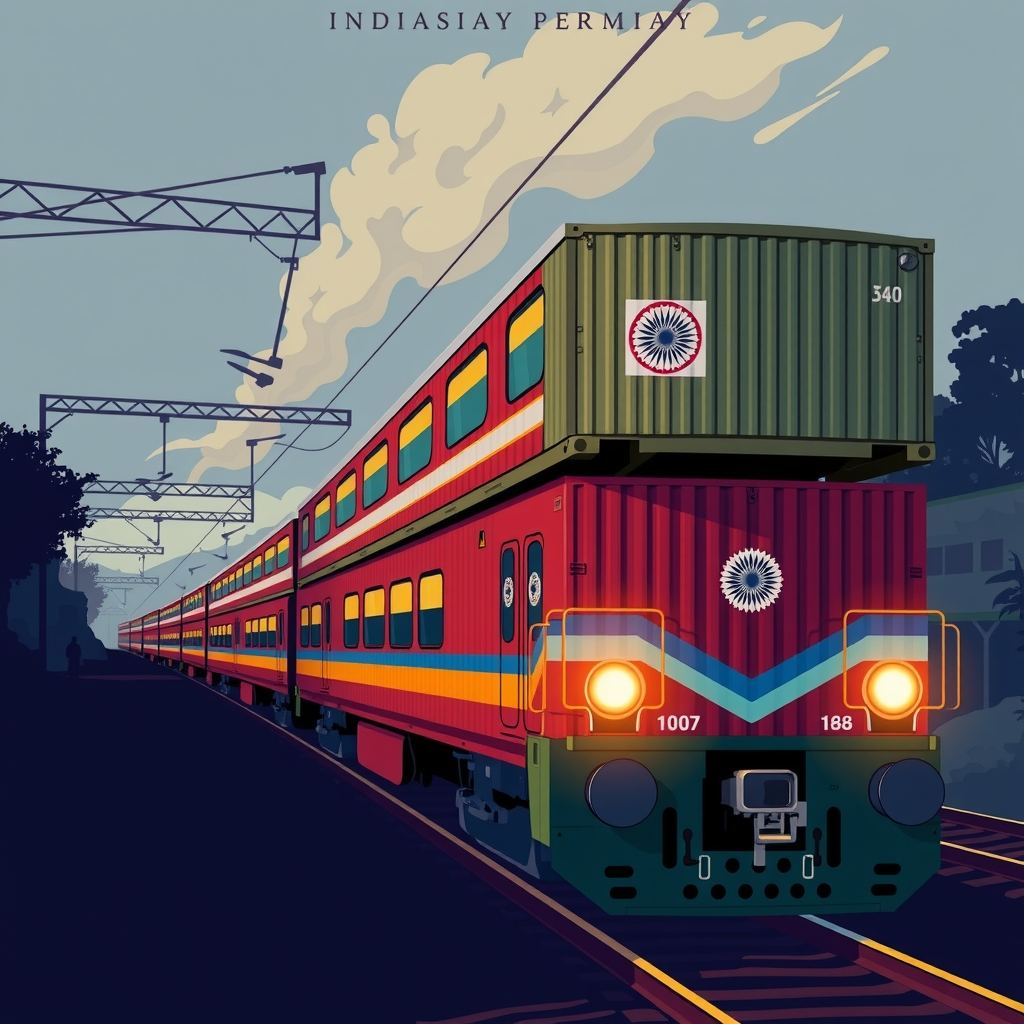
Indian Railways ran its first double-stack long-haul container train on Saturday, hauling 360 containers from the JNPT port in Mumbai to the CONCOR GCT terminal near Vadodara. The 422-kilometre run left at 19:00 hrs on 21 August 2026, marking the nation’s debut of a freight service that stacks containers two high on a single railcar.
Why double-stack matters
Traditional Indian freight trains carry a single layer of containers, limiting cargo per locomotive and forcing more trips. By stacking two TEUs on each flatcar, a double-stack train roughly doubles payload without adding locomotives or lengthening the train. The inaugural run’s 360 TEUs would have required about twice as many conventional wagons.
The road to the first run
India’s rail freight network has been hampered by mixed-traffic lines, low axle loads, and low-clearance corridors. In recent years the rail ministry and freight operators upgraded select routes, reinforced bridges, and raised overhead structures to fit taller cars. The Mumbai-Vadodara corridor, a key east-west freight artery, received those upgrades and enabled the August trial.
Who stands to gain
- Logistics firms can move more cargo per train, cutting fuel use per tonne and lowering operating costs.
- Manufacturers and exporters near the JNPT hub gain a faster, higher-capacity link to inland distribution points, trimming lead times.
- Road transport now faces a new competitor; shifting bulk container traffic to rail could ease highway congestion and cut emissions.
The hidden costs
Building double-stack-compatible routes requires taller bridges, modified tunnels, and reinforced tracks. Only a handful of corridors are cleared, so the benefit stays localized until the network expands. Critics warn the upfront outlay may take years to recoup if freight volumes fail to rise as projected.
What’s next
Indian Railways will test double-stack operations on more long-haul routes, gradually extending the technology beyond the initial corridor. Success depends on how fast other sections are upgraded and whether shippers adopt the service in sufficient numbers to justify further spending.
Takeaway: The inaugural double-stack train shows rail can lift India’s freight capacity dramatically, but scaling the model will need a coordinated rollout of infrastructure upgrades across the country’s rail network.